Pixels and persistent UI state
Modes, active panels, field values, menus, object names, brush headers, and the Blender-drawn paint circle can be read directly when visible.
4:55 output · 4,432 screen captures · 25 Blender checkpoints
We retained the recording one frame at a time, investigated how it was captured, executed the exact Blender 5.1.0 and Ucupaint 2.4.5 pair, and rebuilt the visible process as 25 downloadable checkpoints.
The direct answer
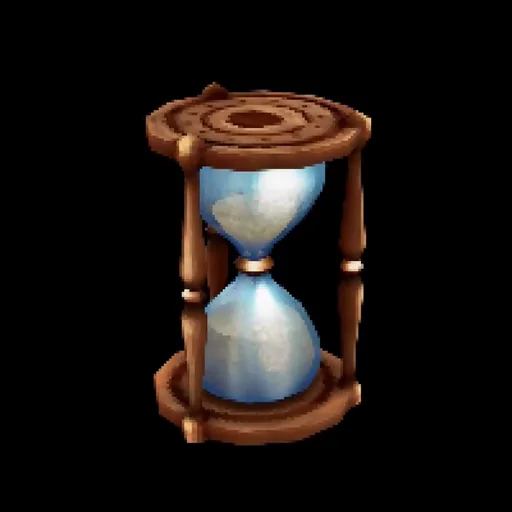
For this asset, SquareAnon deliberately paints form light, edge light, wood grain, trim shine, contact shadow, ornament, glass opacity, and sand variation into different asset channels. The material then combines those channels. A renderer switch alone would not invent those decisions.
First: what the recording contains
The final recorded screen shows Chronolapse set to one second between captures. Those screenshots were encoded at 15 frames per output second: a 4:55 video compresses roughly 74 minutes of work.
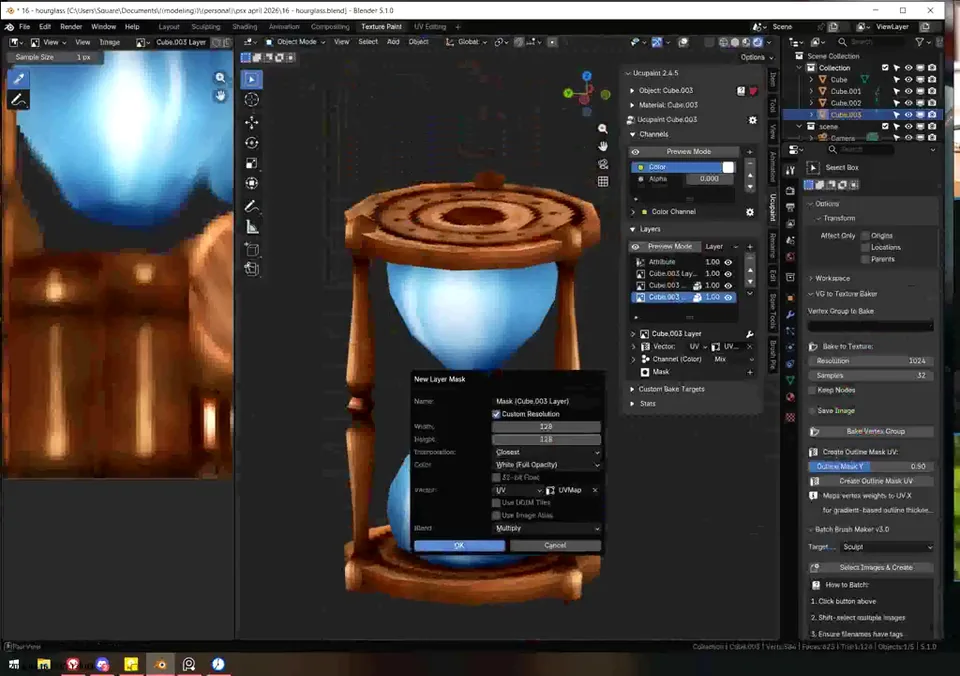
Modes, active panels, field values, menus, object names, brush headers, and the Blender-drawn paint circle can be read directly when visible.
We replayed the recoverable modeling, Ucupaint layer, mask, material, sand, UV, and parenting operations in Blender 5.1.0 with Ucupaint 2.4.5.
Chronolapse captured the screen through a desktop bitmap copy and did not composite the operating-system arrow. A state change can prove an operation occurred without preserving its exact click or key path.
Five-frame worked example
Swipe the table to reveal the claim boundary →
| Frame | Visible state | What it supports | What it cannot prove |
|---|---|---|---|
| F3330 | New Image dialog, 1024×1024, Closest | Initial mask-image settings are visible. | The precise mouse path, click coordinates, and keystrokes between one-second captures were not recorded. |
| F3331 | Width field is being edited | A dimension change is underway. | |
| F3332 | Width 128; height field active | The first exact replacement value is visible. | |
| F3333 | Width 128, height 128, Closest | The final dialog contract is directly observed. | |
| F3334 | Dialog closed; white mask layer exists | Creation succeeded between adjacent snapshots. |
Bit-by-bit Blender reconstruction
Each stage is a separate `.blend`, rendered from one fixed camera. The replay follows visible source states; it is not SquareAnon’s original file and does not fabricate hidden brush telemetry.
Swipe to reach every reconstruction phase →
The checkpoint manifest is loading.
Do not settle for screenshots
The archive contains 25 ordered `.blend` files, the three tiny texture images, and the replay manifest. The final file opens directly in Blender.
Original-resolution micro audit
This is the forensic layer beneath the 33-step teaching summary. Search exact controls, objects, modes, brush values, visible cursor evidence, and the before/after state recorded across the main timelapse and companion result.
The ledger preserves every recoverable visible Blender brush circle. It cannot recover an operating-system pointer, tablet pressure, click, key, or movement that occurred between Chronolapse’s one-second screenshots. The published native-visual receipt list enumerates every original PNG and proves exact coverage.
Loading the micro-event ledger…
What actually makes the image
The video’s unusual quality comes from breaking the standard physically based division of labor. The artist keeps visual authority close to the asset.
Bulbs, plates, one turned post, radial repetition, and a bulb-derived sand pile establish the big read.
Shells, strips, caps, rings, and collars are packed by hand so the tiny atlas spends pixels intentionally.
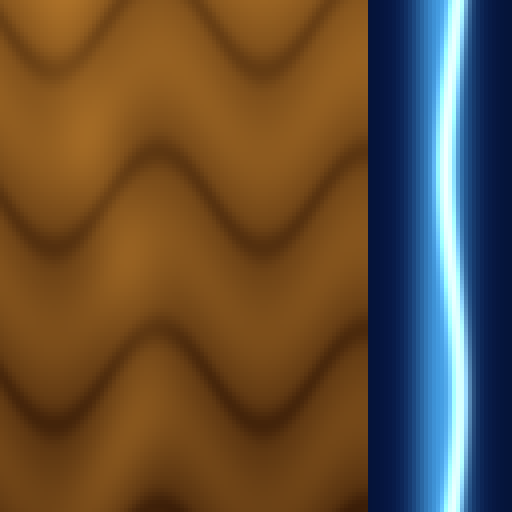
Closest filtering preserves hard, chunky pixel decisions. Blue glass and warm wood share one image.
White centers, cobalt rims, warm edge light, wood grain, contact shadow, and trim shine are authored into color.
Separate attributes darken wood undersides and add another controllable glass gradient.
Black, grey, and white strokes art-direct where the painted glass appears transparent.
The visible material summary mixes Transparent BSDF and Emission with a Ucupaint-derived factor.
A tiny painted sand image covers the piles; the falling stream reuses it by moving its UVs.
Executed Blender proof
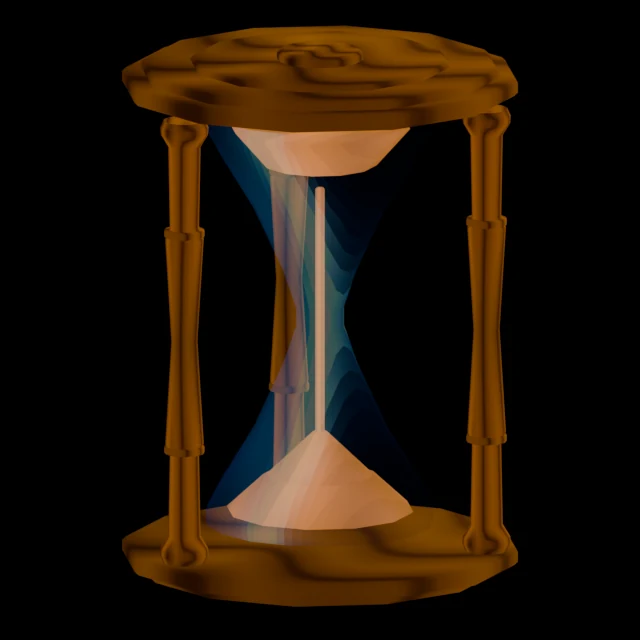
This is our deterministic channel-equivalent reconstruction, not SquareAnon’s original `.blend` and not a claim about an unseen node graph. It exists to make each responsibility visible.
 SquareAnon source
Our mechanism proof
SquareAnon source
Our mechanism proof
Honest visual verdict
The reconstruction reproduces the channel structure and a related thumbnail read. It does not reproduce SquareAnon’s hand, exact topology, precise brushwork, or hidden settings. Its two-value aid also shows that our dark wood merges too much with black; this is evidence, not a concealed miss.
Final authored stack
All authored channels enabled.
What your eye should noticeThe intended reconstruction read: warm wood, painted glass, mask, vertex color, sand, and unlit presentation.

Frame-indexed field notes
Filter by responsibility. Every card cites exact frames and time. “Strongly inferred” and “unknown” are never silently promoted to fact.
Swipe to reach every process filter →
Loading the action ledger…
Layman’s repeatable plan
Do not copy the hourglass literally. Copy the division of artistic responsibility, then test it on one approved focal asset before any renderer migration.
Boundaries
Audit trail