Four real open-source rendering approaches. One source asset. Sixteen locally captured views. Separate controls for surface, light, lines, hatch, and whole-frame treatment.
Controls are fixed within each candidate comparison. Malt uses a matched EEVEE proxy baseline; Mœbius and Godot use within-system baselines. Cameras are not falsely matched across engines.
The clearest comic-3D witness.Useful direction signal; visibly not final art.
Your intuition was right.A complete artistic pipeline can rewrite the visual grammar across the frame.
The missing distinction.It cannot invent intentional silhouettes, authored ink, composition, or semantic choices by itself.
00
Asset truth
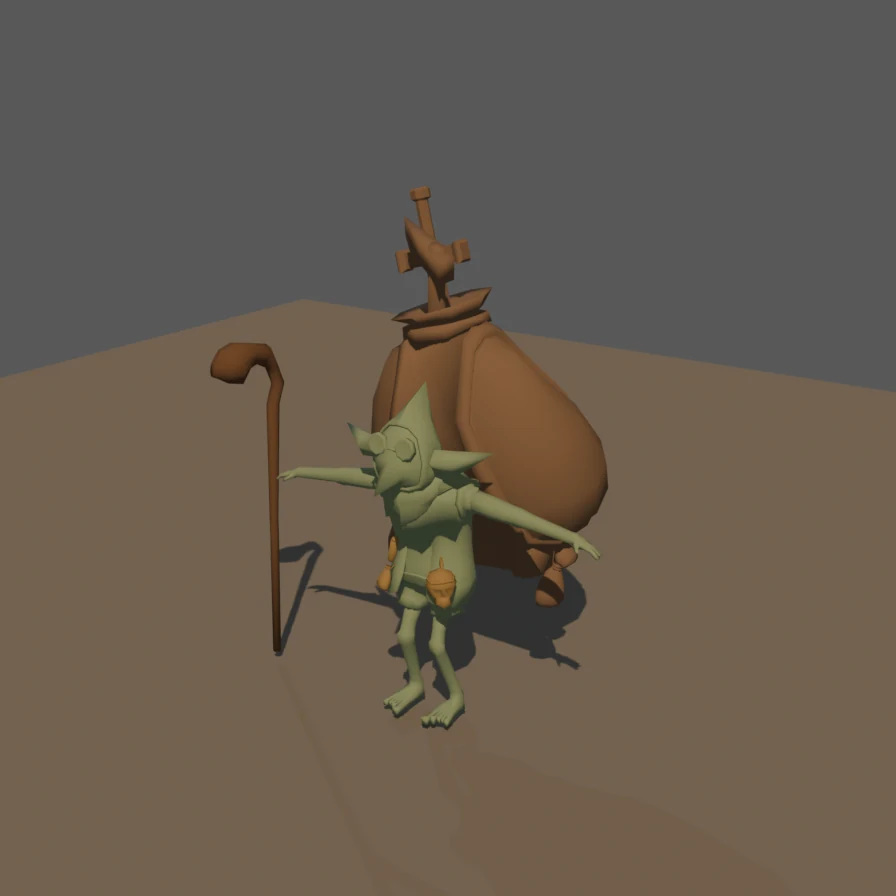
The goblin was never untextured.
Authored 256×256 atlasTexture-suppressed proxy
Verified asset
4 meshes · 6,140 triangles · one embedded base-color atlas · no rig, animation, morphs, tangents, or dedicated semantic-line channel.
Why both inputs exist
The texture proves what authored surface contributes. The proxy removes that contribution so lighting and line mechanisms can be isolated honestly.
Asset SHA-256: 96DF1662…E6A8EC
01
Malt · artistic renderer · MIT
Banding and lines have different jobs.
Choose a stage, then drag the reveal. The left side always stays on the same texture-suppressed neutral baseline.
Neutral proxyFull stack
Banded value and contour structure cooperate to create the strongest comic-3D transformation in the trial.
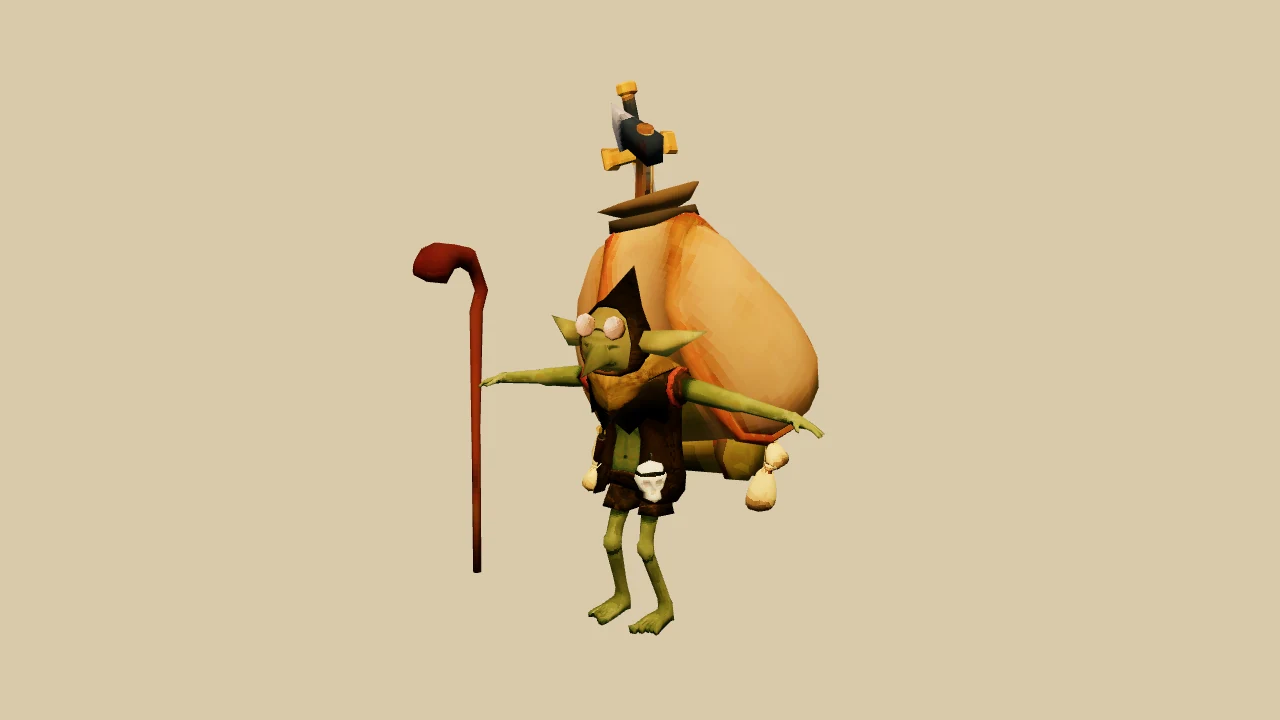
This controlled Three.js adaptation keeps the textured goblin, camera, light, and background fixed. Only the post stage changes.
Neutral texturedFull stack
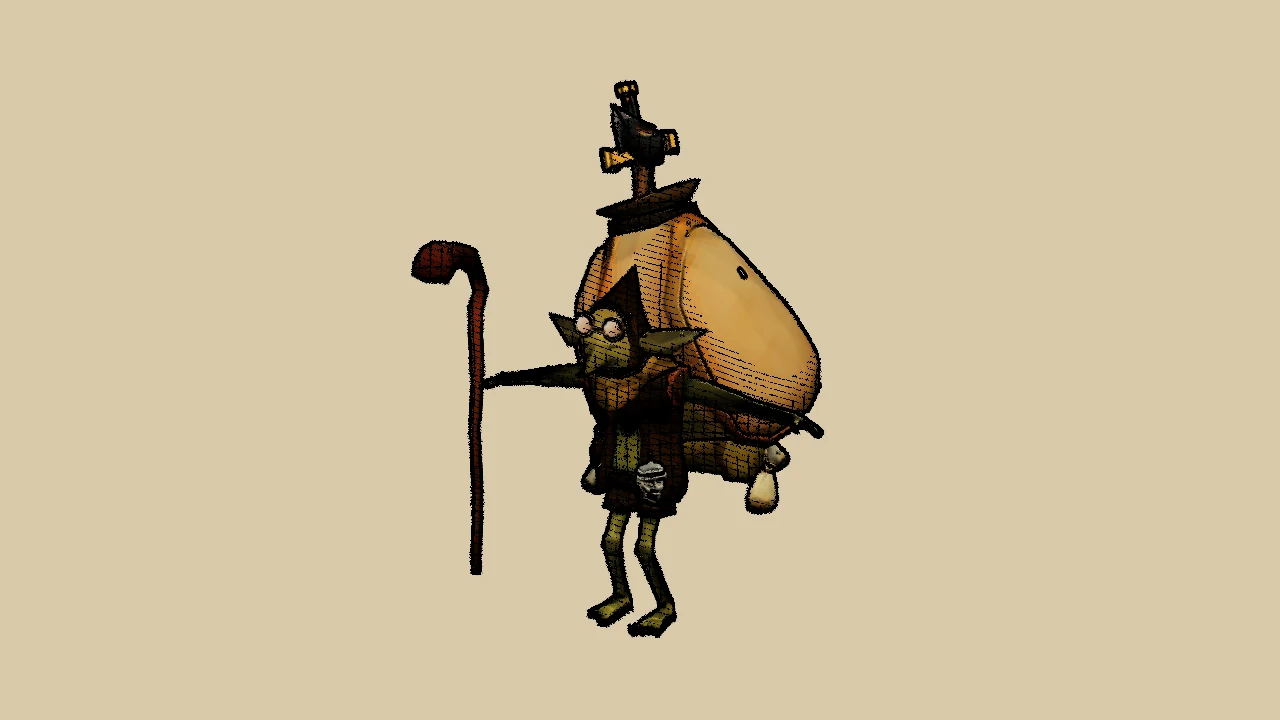
The complete pass unmistakably morphs the asset, but its strongest identity is also its largest failure: everything is equally inked.
Changed
Depth, normals, hatch, composite
Critical flaw
Over-dark and hierarchy-blind.
Controlled adaptation of Maxime Heckel source 33f52b · WebGL2 / RTX D3D11 · the article’s embedded witness pins Three r149, and this extraction preserves that stack; production uses r184.
03
Whole-frame and geometry witnesses
Two more meanings of “renderer.”
Godot PSX demo · MIT
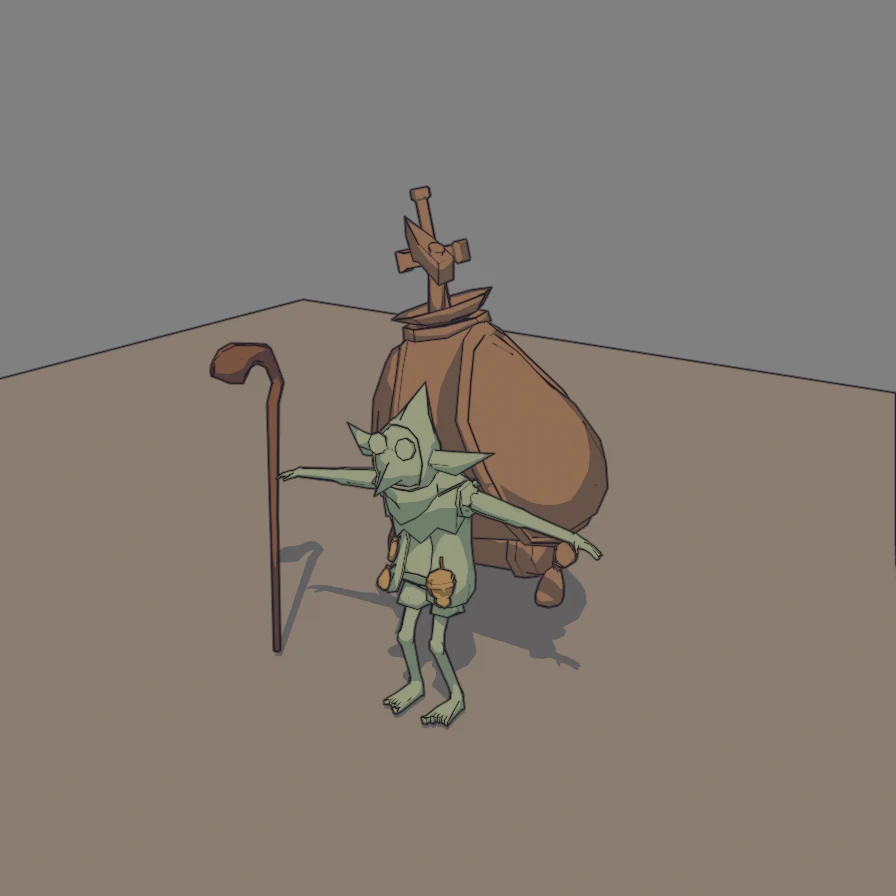
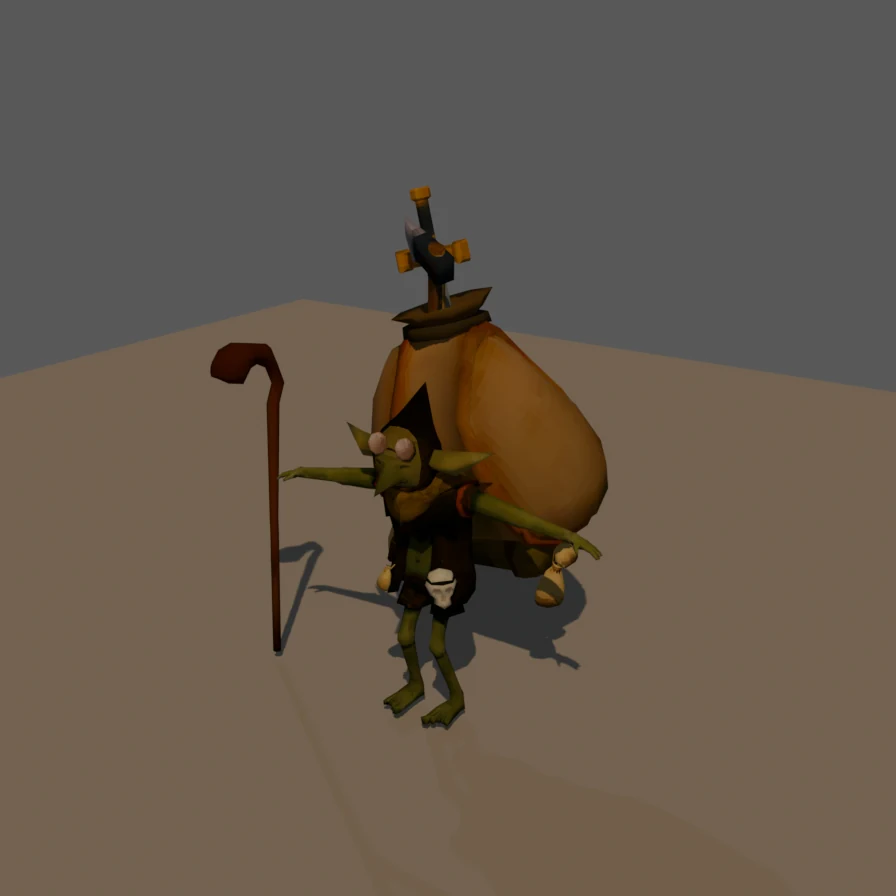
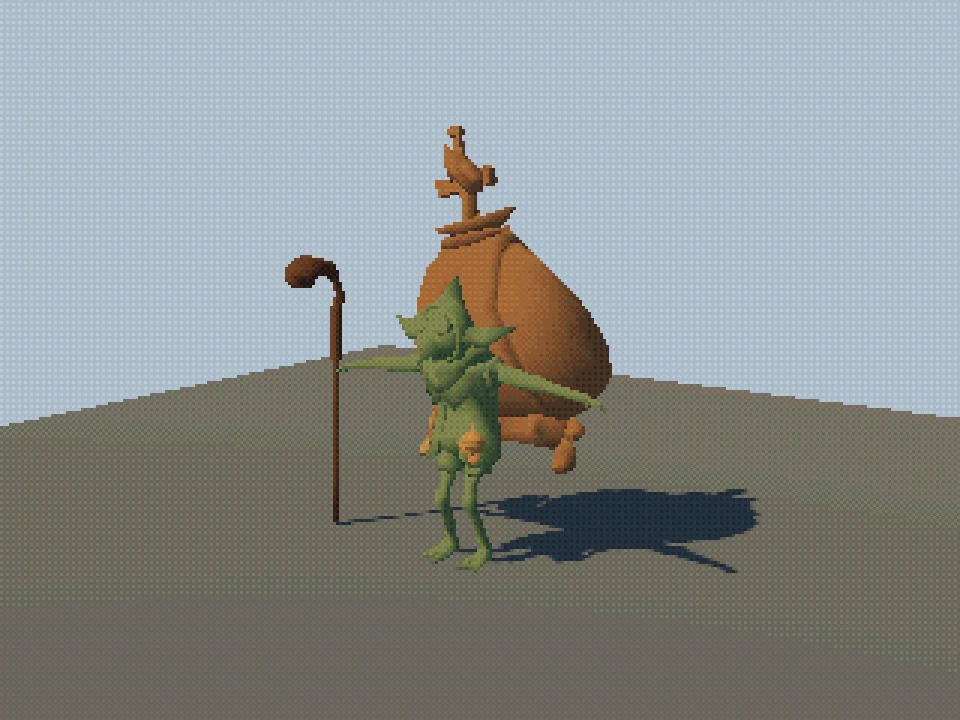
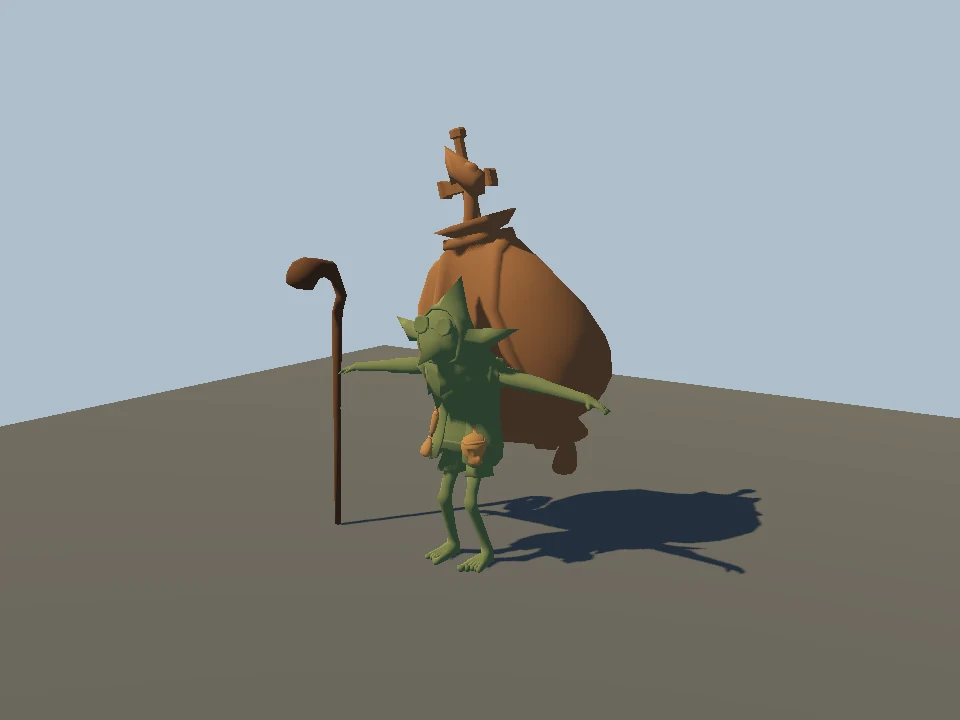
A full stack reaches every pixel.
StandardFull PSX
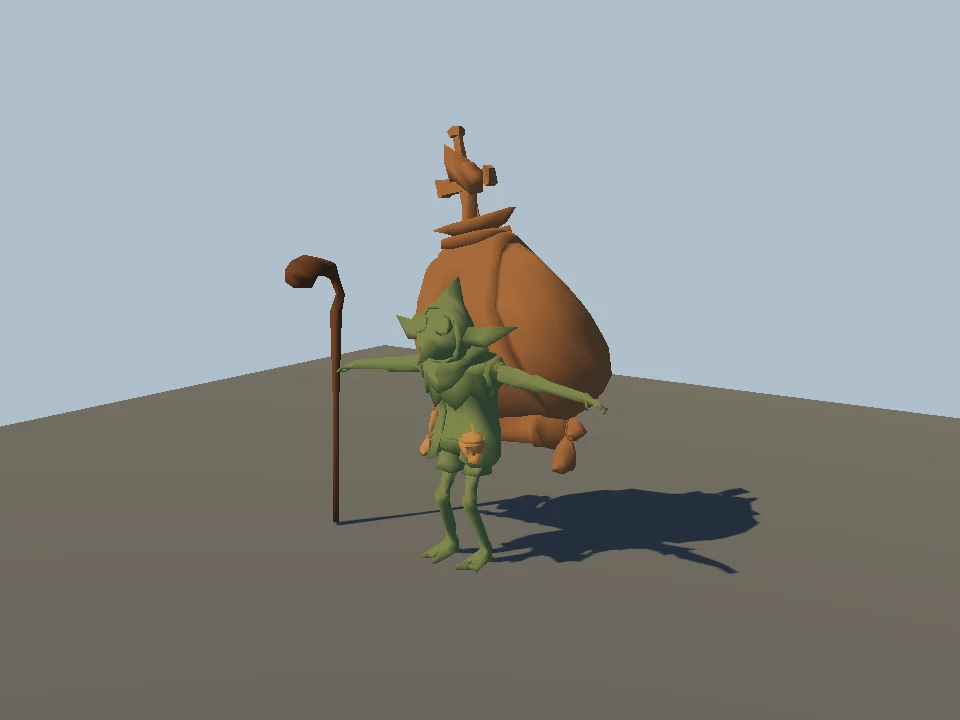
Lesson: the material stage adds vertex snapping and vertex-lit response; low resolution, color banding, dithering, and final processing change the whole frame. This is reach evidence, not a proposed aesthetic.
Material-only middle stage
Krbn · MIT
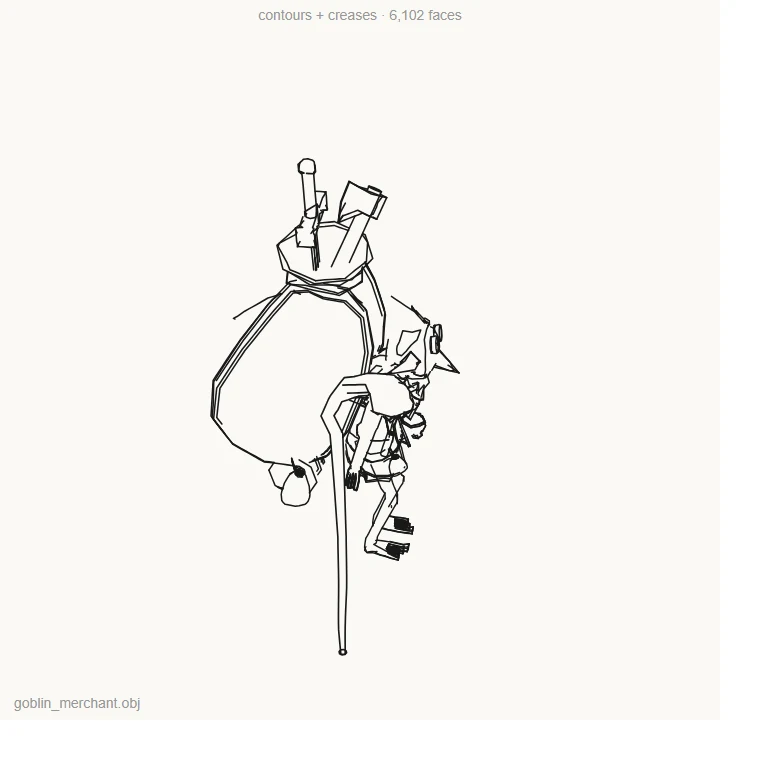
Lines can come from geometry, not pixels.
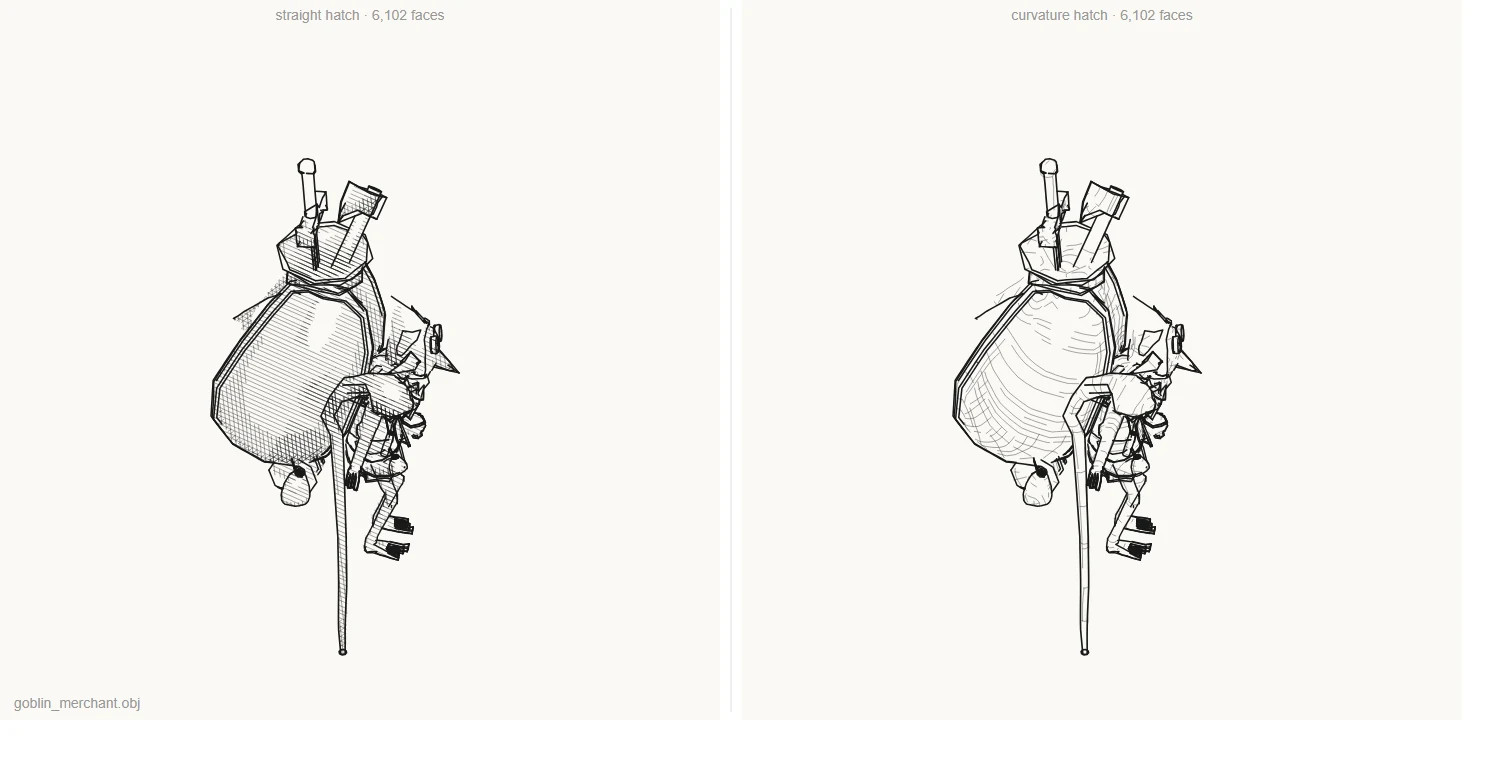
Lesson: curvature-following strokes wrap the backpack more intentionally than a screen-space grid. Krbn is an offline SVG renderer, so this is a design clue—not real-time compatibility proof. Its import normalizes and welds the export from 6,140 to 6,102 faces: same source asset, not bit-identical topology.
Contour and crease source
04
What the references actually teach
Sable is a comic-world pipeline, not an outline filter.
Its renderer participates heavily, but the documented look also depends on art authored specifically for that renderer.
Authored formLow-poly masses, selected wobble, deliberate construction shapes.sable-gdc@04:37;15:39–15:57
Paint and ink surfaceHand-drawn color and black/white texture patterns made in concert with the model.@16:01–16:38
Flat base + cast shadowGraphic fill still receives grounding and readable world shadow.@07:25–08:02
Three line sourcesAutomatic distance edges + vertex-painted semantic edges + thresholded texture lines.@12:37–14:22; texture ink @13:48–14:22
Distance profilesLine fade, shadow intensity, and biome/time color are coordinated.@08:04–11:44
Motion languageHeld character poses produce a drawn rhythm; our static, unrigged goblin cannot test this.@15:16–15:36
Goblin currently has: low-poly form, one painted atlas, and geometry for automatic edges.
Goblin currently lacks: a dedicated semantic-line channel, verified Sable-authored ink data, distance profiles, and a rigged motion witness.
05
Constructive synthesis
Our inspirations want different jobs.
SableSelective comic line grammar and intentional imperfection.GDC @12:37–14:22Square AnonAuthored surface character, brush marks, and material story.Artist post + painted assetValheimCoarse form that survives strong modern atmosphere.Official visual-style FAQJourney · BOTW · FirewatchWorld-scale value, atmospheric depth, color, composition, and environmental response.Primary talks: Journey @11:55–20:12; BOTW @42:47–50:28; Firewatch @06:24–14:11
Best current hypothesis—not a verdict
Painted graphic fantasy + selective living ink + sky-led atmosphere.
Use authored paint as one candidate for surface authority; automatic depth edges as a floor; semantic inclusions/exclusions for intention; restrained normal lines; distance-aware fading; and world lighting that preserves two-value readability. Keep paint-versus-shader authority open until the next controlled proof.
Keep exploring
Malt’s separation of value and line roles; Mœbius depth silhouettes; Krbn’s form-following strokes; world-wide output law.
Do differently
No blanket hatch, no equal-weight internal lines, no “comic = black outline,” and no isolated goblin beauty claim without a composed world frame.
06
Creative Director checkpoint
Leave with a decision, not another discussion.
Choose the strongest direction signal and the mechanism worth prototyping. This page creates a verdict note; it does not change the renderer.
Stop point: send the verdict back before any direct Three r184 implementation or editor migration.
All screenshots in this bundle are local captures of the commissioned goblin or its texture-suppressed proxy; no external reference art is republished.
Malt is a tuned Blender proof. Mœbius is a controlled adaptation of an r149 study. Godot proves pipeline reach. Krbn is offline SVG.
No trial establishes r184 integration, GPU cost, temporal stability, skinning, crowds, disposal, world composition, or final beauty.
Static evidence cannot test Sable-like held motion because the GLB has no rig or animation.
 StandardFull PSX
 Material-only middle stage